Fluorination chemistry routes fall into a small number of mechanistic families, and choosing badly between them costs more program time than almost any other route decision in medicinal chemistry. Roughly a fifth to a quarter of marketed small-molecule drugs now carry at least one fluorine atom, and the fraction is higher in recent approvals, because a single fluorine can block a metabolic hotspot, shift a nearby pKa by one to two units, lock a conformation, or move logD without adding meaningful molecular weight. Getting that fluorine into the molecule is the hard part. Nucleophilic, electrophilic, and radical methods each have narrow substrate windows; the reagents that work best on scale are often the ones with the worst thermal profiles; and anhydrous hydrogen fluoride is a hazard most contract labs will not touch at any price. This guide covers the routes, the selectivity trade-offs, the buy-versus-make decision that most programs get wrong, and the safety and analytical practices that separate a fluorination that scales from one that stops at 5 grams.
Fluorination chemistry routes are the most consequential and most frequently mishandled decision in modern medicinal chemistry route design. The reason is structural: fluorine is not a substituent you can install the way you install a methyl or a chloride. There is no general, mild, selective, scalable method that works across substrate classes. Instead there are perhaps six mechanistic families, each with a narrow substrate window, and the cost of picking the wrong one is not a low yield — it is a route that works at 200 milligrams and fails completely at 2 kilograms.
That matters more every year. Fluorine appears in roughly 20 to 25 percent of marketed small-molecule pharmaceuticals and in a higher fraction of recent approvals, and in agrochemicals the proportion is higher still. The reason is not fashion. Fluorine solves a specific and recurring class of problems — metabolic instability, unwanted basicity, poor permeability, weak binding at a particular vector — with a modification that adds 18 mass units and almost no steric penalty. When a medicinal chemistry team hits a metabolic soft spot in a lead series, fluorine is very often the cheapest fix available in structure-activity terms. It is rarely the cheapest fix in synthetic terms.
This post is our hub for fluorination work: what the routes are, when each one applies, what the safety burden actually looks like at scale, and the buy-versus-make calculation that should precede all of it. It anchors the deepest part of our catalog — the fluorinated compounds category runs to thousands of items — and the practical conclusion of most of what follows is that buying one of those items beats running the chemistry yourself.
Why Fluorine: The Five Mechanisms That Actually Matter
Fluorine changes molecular behavior through five distinct and largely independent mechanisms. Understanding which one you are trying to exploit determines where the fluorine has to go, and therefore which route you need.
Metabolic Blocking at Oxidative Hotspots
The most common reason to fluorinate. Cytochrome P450 enzymes hydroxylate carbon-hydrogen bonds, preferentially at electron-rich, sterically accessible positions — para positions on aryl rings, benzylic carbons, positions alpha to heteroatoms. The carbon-fluorine bond has a bond dissociation energy in the region of 105 to 110 kcal per mole, well above the roughly 98 to 101 kcal per mole of an aliphatic carbon-hydrogen bond, and P450 chemistry cannot abstract it under physiological conditions. Replacing the hydrogen at a known site of metabolism with fluorine removes that pathway.
Two caveats worth stating. First, blocking one site frequently redirects metabolism to the next most accessible position rather than eliminating clearance — this is metabolic switching, and it is why teams sometimes end up fluorinating twice. Second, fluorine also withdraws electron density from the ring, which suppresses oxidation at positions it does not occupy. The effect is both steric-electronic and positional, so an ortho or meta fluorine can protect a para position indirectly.
pKa Modulation of Nearby Basic and Acidic Centers
Fluorine is the most electronegative element, and its inductive withdrawal propagates through sigma bonds with a strong distance dependence. A fluorine beta to a basic amine typically lowers the amine pKa by roughly 1.5 to 2 units; gamma placement drops it by perhaps 0.5 to 1. The classic worked example is a piperidine nitrogen: an unsubstituted piperidine sits near pKa 11 and is essentially fully protonated at physiological pH, while a 4,4-difluoro substitution pulls that down toward pKa 8 to 9, materially increasing the neutral fraction available to cross a membrane.
This is exactly why 4,4-Difluoropiperidine (CAS 21987-29-1) and (3R)-3-Fluoropyrrolidine (CAS 679431-51-7) appear so often in CNS and kinase programs. The fluorines are not there for binding. They are there to move the pKa of the ring nitrogen into a window where the compound is both soluble enough to formulate and neutral enough to permeate. Our piperidines and piperazines category carries the common variants because this substitution is so heavily used.
The same logic runs in the other direction for acids. Fluorine alpha or beta to a carboxylic acid raises acidity, and fluorination of a phenol ring drops the phenol pKa by roughly one unit per fluorine depending on position — relevant when a phenol is a binding element and you want to control its ionization state.
Conformational Control
The fluorine gauche effect is real and exploitable. In a 1,2-fluoro-amine or 1,2-fluoro-alcohol motif, the fluorine and the heteroatom prefer a gauche relationship rather than the anti arrangement sterics would predict, because of hyperconjugative stabilization from the adjacent carbon-hydrogen sigma bond into the carbon-fluorine sigma-star orbital. On a ring, fluorine’s conformational preference is weak — it barely distinguishes axial from equatorial — but on a flexible chain, a single fluorine can bias the population of bound-like conformations enough to gain a factor of several in potency without touching a single contact atom.
Fluorine on a ring adjacent to an amide can also enforce planarity or twist by electrostatic interaction with the carbonyl. These effects are subtle, often worth half a log unit rather than two, and they are the hardest to predict prospectively.
Lipophilicity and Membrane Permeability
Fluorine’s effect on lipophilicity is not monotonic and is widely misremembered. Aromatic fluorination generally raises logP modestly, by roughly 0.1 to 0.25 per fluorine. Trifluoromethyl on an aromatic ring raises it substantially, often 0.8 to 1.0. But a single fluorine on an aliphatic chain, particularly near a polar group, can lower logD because it reduces the basicity of a nearby amine and therefore the ionized fraction. A CF3 adjacent to an alcohol makes that alcohol more acidic and more polar. The honest summary is that fluorine’s effect on measured logD is dominated by its pKa effect whenever an ionizable group is nearby, and by its intrinsic lipophilicity only when there is not.
The Carbon-Fluorine Bond Itself
The bond is short (around 1.35 angstroms), strong, and highly polarized, with the negative end on fluorine. It is a very poor hydrogen bond acceptor — considerably worse than an ether oxygen — which is why ‘the fluorine picks up a hydrogen bond’ is usually the wrong explanation for a potency jump. What fluorine does contribute is a well-defined dipole that can interact favorably with backbone amides, and a low-polarizability surface that fills small hydrophobic pockets efficiently.
Nucleophilic Fluorination: Delivering Fluoride as an Anion
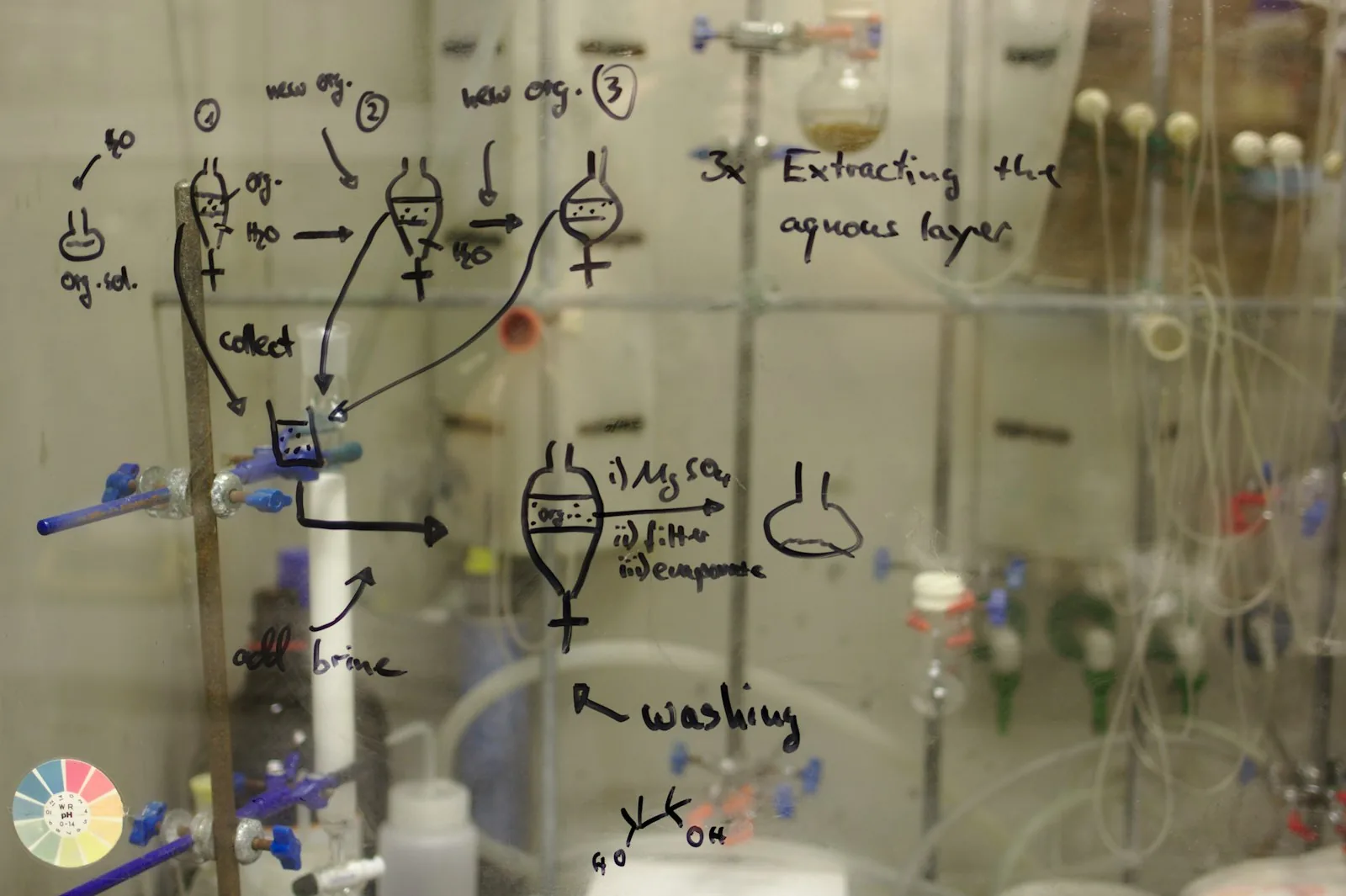
Nucleophilic fluorination is the workhorse of industrial fluorine chemistry, and it requires an electron-poor substrate with a leaving group. The core difficulty is that fluoride is a small, hard, strongly solvated anion: in protic solvent it is a poor nucleophile and a good base, so nucleophilic fluorination is largely a problem of desolvating fluoride without eliminating everything in the flask.
Halex and SNAr on Activated Aromatics
The halogen exchange (halex) reaction displaces chloride from an activated aromatic with fluoride, typically potassium fluoride or cesium fluoride, in a dipolar aprotic solvent such as sulfolane, DMSO, or NMP at 150 to 220 degrees Celsius. It is the dominant industrial route to fluoroaromatics, and it works because the aromatic ring bears activating groups — nitro, cyano, carbonyl, or a ring nitrogen — that stabilize the Meisenheimer intermediate.
The practical constraints are worth stating plainly:
- Activation is mandatory. An unactivated chlorobenzene will not undergo halex at any reasonable temperature. Ring nitrogen counts as activation, which is why fluoropyridines are far more accessible by halex than fluorobenzenes.
- Water is the enemy. Trace water hydrates fluoride and kills the reaction. Fluoride sources are typically spray-dried or azeotropically dried, and Karl Fischer on the reaction mixture before charging is a standard control.
- Temperature drives decomposition. Sulfolane at 200 degrees Celsius over 12 hours generates its own degradation products, and these are a recurring source of colored impurities that are hard to remove.
- Selectivity in polyhalogenated substrates follows activation, not leaving-group ability, so predicting which chloride exchanges in a dichloro substrate requires thinking about the ring, not the halide.
Fluorinated pyridines and indoles from this chemistry are among the most-requested building blocks in discovery. Compounds like 3-Trifluoromethyl Pyridine (CAS 3796-23-4) and the fluoroindoles 4-Fluoroindole (CAS 387-43-9) and 5-Fluoroindole (CAS 399-52-0) exist commercially precisely because these ring systems tolerate the chemistry well at manufacturing scale. Related cores sit in our heterocyclic compounds category, and the scale-up considerations for those ring systems are covered in heterocycle synthesis at scale.
Deoxyfluorination of Alcohols and Carbonyls
Deoxyfluorination converts an alcohol to an alkyl fluoride, or a ketone or aldehyde to a gem-difluoride, by activating the oxygen and displacing it with fluoride. The reagent family is the sulfur-based aminosulfur trifluorides.
DAST (diethylaminosulfur trifluoride) is the historical standard and remains extremely common in discovery. It is also the reagent most responsible for fluorination chemistry’s reputation as dangerous on scale. DAST decomposes exothermically with reported onset in the region of 50 degrees Celsius, evolving gas and generating HF, and there are documented incidents of violent decomposition and detonation on distillation or on bulk heating. The self-accelerating decomposition temperature falls as the batch size rises, which is exactly the wrong behavior for scale-up. A DAST reaction that runs uneventfully on 5 grams is not evidence that it will run on 5 kilograms.
Deoxo-Fluor (bis(2-methoxyethyl)aminosulfur trifluoride) was developed specifically to address this. Its decomposition onset sits materially higher, generally reported near 140 degrees Celsius, which gives a much wider margin between operating temperature and runaway. It is the default substitution when a DAST route needs to leave the laboratory.
Xtalfluor-E and Xtalfluor-M are crystalline aminodifluorosulfinium salts that are thermally more robust still and easier to charge accurately. They require an external fluoride source and a promoter, which adds a variable, but they remove the pyrophoric-liquid handling problem entirely.
The non-negotiable process step for any of these on scale is thermal screening of the actual reaction mixture — DSC as a minimum, accelerating rate calorimetry where the scale justifies it — because the decomposition behavior of the reagent in your solvent with your substrate is not the same as the neat reagent’s published onset. This is standard practice in the discipline described in process chemistry optimization from lab to pilot.
Deoxyfluorination also has an intrinsic selectivity problem: the activated intermediate is a good leaving group, so elimination to the alkene competes with substitution, and neighboring-group participation can scramble stereochemistry at the reacting center. Secondary alcohols are the hardest case. Yields in the 40 to 70 percent range with an alkene byproduct are normal, not a sign of a bad experimentalist.
Alkali Metal Fluorides with Phase-Transfer Catalysis
Potassium fluoride is cheap, safe, and almost useless as a nucleophile in its native lattice. Making it work means either dissolving it in a dipolar aprotic solvent at high temperature (the halex conditions above) or lifting fluoride into an organic phase with a phase-transfer catalyst. Tetrabutylammonium salts, crown ethers such as 18-crown-6, and more recently oligoethylene glycol and bulky ammonium promoters all function by encapsulating the potassium cation and leaving fluoride relatively naked and reactive.
Cesium fluoride is more soluble and more reactive than potassium fluoride and is often the laboratory choice, at a materially higher cost per mole. Tetrabutylammonium fluoride is highly reactive but essentially impossible to dry completely — the commercial trihydrate carries enough water to compromise sensitive substrates, and attempts to dry it fully cause Hofmann elimination of the cation.
The practical decision table for nucleophilic sources:
| Fluoride source | Typical use | Reactivity | Main limitation |
|---|---|---|---|
| KF, spray-dried | Halex on activated arenes, scale | Low without help | Needs 150-220 °C, rigorous drying |
| CsF | Lab-scale SNAr, milder halex | Moderate | Cost, hygroscopic |
| KF plus crown or PTC | Aliphatic substitution | Moderate to high | Catalyst removal, cost at scale |
| TBAF | Silyl deprotection, some SN2 | High | Cannot be fully dried, basic |
| DAST | Alcohol to fluoride, C=O to CF2 | High | Thermal instability, scale hazard |
| Deoxo-Fluor | Same as DAST, scalable | High | Cost, still HF-generating |
| Xtalfluor-E/M | Same, crystalline handling | Moderate | Needs promoter and F source |
Electrophilic Fluorination: Delivering Formally Positive Fluorine
Electrophilic fluorination is the complementary disconnection: it delivers fluorine to an electron-rich carbon, which means enolates, enol ethers, silyl enol ethers, activated arenes, and electron-rich heterocycles. Because elemental fluorine itself is uncontrollable in most organic settings, the practical reagents are all N-F compounds that carry fluorine on a nitrogen bearing electron-withdrawing groups.
Selectfluor and NFSI
Selectfluor (1-chloromethyl-4-fluoro-1,4-diazoniabicyclo[2.2.2]octane bis(tetrafluoroborate)) is a stable, crystalline, non-hygroscopic solid, safe to weigh on the bench, and soluble in acetonitrile and water. It is the more reactive of the two common reagents and is the default for enolate and enol ether fluorination, for fluorination of 1,3-dicarbonyls, and increasingly as a single-electron oxidant in radical fluorination and fluoroalkylation chemistry.
NFSI (N-fluorobenzenesulfonimide) is less reactive, more soluble in organic solvents, and generally more selective. It is the reagent of choice for monofluorination where Selectfluor over-fluorinates, and it is the standard partner for catalytic enantioselective fluorination using cinchona-derived phase-transfer catalysts or chiral Lewis acid systems.
How Do You Control Selectivity in Electrophilic Fluorination?
Three failure modes dominate electrophilic fluorination, and each has a standard remedy:
- Over-fluorination. A monofluorinated 1,3-dicarbonyl is still acidic enough to enolize and fluorinate again. The fix is to pre-form a defined enolate equivalent — a silyl enol ether or an isolated enol acetate — rather than generating the enolate in situ under the fluorination conditions.
- Regiochemical scrambling. An unsymmetrical ketone gives a mixture unless the enolate geometry and position are fixed before the reagent is added. Kinetic enolate formation at low temperature followed by silyl trapping is the reliable route.
- Arene positional mixtures. Direct electrophilic fluorination of an activated arene follows normal ortho and para directing rules and rarely gives a single isomer cleanly. For a defined aryl fluoride, halex or a Balz-Schiemann-type diazonium route usually beats direct electrophilic attack — or, more sensibly, buy the ring already fluorinated.
That last point deserves emphasis. Defined difluorophenol substitution patterns like 2,4-Difluorophenol (CAS 367-27-1) and 3,5-Difluorophenol (CAS 2713-34-0) are effectively impossible to make selectively by direct fluorination of phenol, and are manufactured by dedicated routes. They and their analogs sit in the alcohols and phenols category as finished building blocks for exactly this reason.
Trifluoromethylation: Why CF3 Is Everywhere
The trifluoromethyl group is the single most prevalent fluorinated motif in pharmaceuticals and agrochemicals, and the reason is that it does several jobs at once. It is strongly electron-withdrawing, with a Hammett sigma-para value around 0.54; it is strongly lipophilic on an aromatic ring; it is essentially inert to metabolism; and it is roughly the steric size of an isopropyl group. A CF3 substituent can simultaneously block metabolism, tune the electronics of an adjacent ring nitrogen, and fill a hydrophobic pocket. Few other single substituents do that.
Nucleophilic: The Ruppert-Prakash Reagent
TMSCF3 (trimethyl(trifluoromethyl)silane) is the standard nucleophilic trifluoromethyl source. Activated by a fluoride initiator — TBAF, CsF, or a catalytic amount of an alkoxide — it delivers the trifluoromethyl anion equivalent to aldehydes, ketones, imines, and disulfides. The reaction is autocatalytic in alkoxide once initiated, generally runs at or below room temperature, and is one of the more reliable transformations in the field. Its limitation is that it gives you a CF3-carbinol or a CF3-amine, not an aryl-CF3.
Radical Trifluoromethylation
The CF3 radical is generated from Langlois reagent (sodium triflinate) with an oxidant, from Togni-type hypervalent iodine reagents, from Umemoto sulfonium salts, or photocatalytically from a range of precursors. It adds to electron-rich heteroarenes at useful rates and is the basis of most late-stage trifluoromethylation methodology. The strength is that it needs no pre-functionalization. The weakness is selectivity: on a substrate with multiple similarly electron-rich positions, you get a mixture, and separating regioisomeric CF3 products by chromatography at scale is expensive.
Copper-Mediated and Cross-Coupling Approaches
Copper-mediated trifluoromethylation of aryl halides and boronic acids gives the defined regiochemistry that radical methods do not. Historic versions used stoichiometric copper with methyl fluorosulfonyldifluoroacetate at high temperature; modern versions use well-defined copper-CF3 complexes or catalytic systems with a separate CF3 source. Palladium-catalyzed variants exist, but reductive elimination of an aryl-CF3 bond is difficult and requires specialized ligands, which is why the palladium route has never displaced copper industrially.
For most programs the honest answer is that the aryl-CF3 building block is cheaper than the coupling. 4-(Trifluoromethyl)phenol (CAS 402-45-9) and 5-(Trifluoromethyl)indole (CAS 100846-24-0) are made industrially by routes no discovery lab would attempt, and they sit alongside several thousand relatives in the fluorinated compounds catalog.
Difluoromethylation and the Emerging Groups
Difluoromethyl (CHF2) is increasingly used as a lipophilic hydrogen-bond donor. The C-H of a CHF2 group is acidified enough by the two adjacent fluorines to act as a weak donor, which makes it a recognized bioisostere for a hydroxyl or a thiol without the metabolic liability of either. Reagents include difluorocarbene sources such as sodium chlorodifluoroacetate and TMSCF2H-based systems for direct difluoromethylation of heteroatoms and, with more difficulty, of carbon.
Trifluoromethoxy (OCF3) is more lipophilic than CF3 and has a distinctive conformational preference — it sits roughly perpendicular to an aromatic ring rather than in plane, which changes the shape it presents to a binding site. Direct installation remains genuinely hard, and most OCF3 compounds are made from dedicated aryl-OCF3 precursors rather than by late-stage trifluoromethoxylation.
Pentafluorosulfanyl (SF5) is sometimes called the super-trifluoromethyl group: more electron-withdrawing than CF3, more lipophilic, octahedral rather than tetrahedral, and chemically very robust. Its use is limited almost entirely by building block availability and cost — SF5 chemistry starts from elemental fluorine or SF5Cl and is not something a typical CRO runs. If a program wants SF5, the practical route is to find a supplier of the specific SF5 building block and design the molecule around what exists.
Late-Stage Versus Early-Stage Fluorination: The Strategic Trade-Off
The decision of where in the route to install fluorine is a genuine trade-off with no default answer, and it should be made deliberately rather than by accident of what reagent someone had on the shelf.
Late-stage fluorination installs fluorine on or near the final molecule. Its advantage is enormous in analog work: one advanced intermediate branches into a series of fluorinated analogs without re-running the route each time. Its disadvantages are that selectivity is at its worst on a complex, multi-functional substrate; that any purification problem hits your most valuable material; and that a mixture of regioisomers at the last step is far more expensive to resolve than a mixture at step two.
Early-stage fluorination builds the fluorine in at or near the starting material, usually by buying a fluorinated building block. Selectivity is straightforward because the substrate is simple. The cost is that every subsequent step must tolerate the fluorine — which is usually fine, since C-F is robust, but not always. Fluorine ortho to a leaving group can undergo unintended SNAr; a benzylic or allylic fluoride can ionize; a gem-difluoride adjacent to a carbanion can eliminate to a vinyl fluoride.
| Consideration | Late-stage | Early-stage |
|---|---|---|
| Step count | Often lower | Higher, fluorine carried through |
| Selectivity risk | High, complex substrate | Low, simple substrate |
| Cost of failure | Loses advanced material | Loses cheap material |
| Analog series | Excellent, one branch point | Poor, re-run route per analog |
| Scale-up predictability | Poor | Good |
| Typical best fit | Discovery, SAR expansion | Development, manufacturing |
The pattern that works in practice is late-stage for discovery SAR and early-stage for anything heading toward development. Teams that carry a late-stage fluorination into process development frequently end up redesigning the route anyway, and the redesign almost always moves the fluorine earlier — usually onto a purchased building block.
Buying Versus Making: The Section Most Programs Skip
Most programs should buy a fluorinated building block rather than run a fluorination. This is the single highest-value recommendation in this post, and it is under-followed because running the reaction feels like doing chemistry while placing an order feels like admitting defeat.
The economics are not close. A fluorinated building block from a catalog arrives with a certificate of analysis, a known impurity profile, an established supply chain, and zero HF exposure for your organization. Running the same fluorination in house means reagent cost, a hazard assessment, thermal screening if you are anywhere near scale, materials-of-construction questions, fluoride waste handling, a purification that is usually harder than the reaction itself, and a regioisomer problem you did not previously have.
When Buying Is Clearly Right
- The substitution pattern exists in a catalog. Check first. Fluorinated chemical space is unusually well covered because agrochemical manufacturing built the supply base decades ago.
- You need material now. A catalog item ships in days; a fluorination campaign takes weeks and may not work.
- You are heading toward GMP. A qualified purchased intermediate with a documented supplier is a far easier regulatory conversation than a novel in-house fluorination with no manufacturing history.
- Your fluorination would need HF. Almost no discovery-stage program should be building HF capability.
When Making Is Justified
- No commercial equivalent exists. Heavily substituted fluoro-heterocycles frequently have no catalog entry at any purity, and this is the honest majority of legitimate custom fluorination requests.
- Late-stage installation removes five or more steps. If fluorinating an advanced intermediate collapses a linear sequence, the selectivity risk may well be worth it.
- You need a positional series. Making 2-, 3-, and 4-fluoro analogs of the same advanced scaffold to map an SAR vector is a real reason to run the chemistry, though buying three differently fluorinated starting materials is usually still cheaper if they exist.
- Isotopic labeling. Fluorine-18 work for PET imaging has its own timeline constraints and cannot be purchased as a stable building block.
What Order Should You Ask the Questions In?
Ask, in this order: does the exact building block exist commercially; does a close analog exist that the route could accommodate; can the route be redesigned to start from an available fluorinated material; and only then, what would it cost to run the fluorination. Teams that ask the fourth question first spend months on chemistry that a purchase order would have retired in a week. The same reasoning applies to other strained and specialty motifs — we make the equivalent argument for four-membered rings in oxetane synthesis for drug discovery.
Sourcing constraints matter here too. Fluorinated intermediates are heavily concentrated in a small number of manufacturing regions, and the trade environment has moved. Agrochemical intermediates under new trade rules covers that exposure directly, and pharmaceutical supply chain de-risking provides the framework for ranking and retiring it.
Safety and Scale-Up: The Part That Is Not Negotiable
Fluorination is the area of synthetic chemistry where the gap between ordinary laboratory practice and safe manufacturing practice is widest. This section is deliberately blunt.
Anhydrous HF and Why Most CROs Decline It
Anhydrous hydrogen fluoride is used industrially — Balz-Schiemann variants, HF-pyridine (Olah’s reagent) deoxyfluorinations, hydrofluorination of alkenes and alkynes, and as the fluoride source in several large-scale processes. It is also a material that requires purpose-built infrastructure: dedicated corrosion-resistant transfer lines, gas detection, scrubbing, restricted access, trained personnel with recurrent training, and a medical response plan agreed in advance with a local hospital.
Most contract research organizations, including many that will run every other kind of hazardous chemistry, do not offer anhydrous HF. This is a rational decision rather than a capability gap. The capital cost is high, utilization is low, and the consequence of an incident is severe. When a supplier tells you they do not run neat HF, that is a normal and defensible answer. What you should ask instead is whether they can run HF-pyridine or HF-triethylamine complexes at a defined scale in appropriate containment, which is a much more common capability, or whether the route can be redesigned to avoid HF altogether — usually the right question.
Exotherm Management
Fluorination reactions are frequently strongly exothermic, and several of the common reagents have decomposition exotherms that the reaction exotherm itself can trigger. The controls are standard process safety practice applied with more than usual seriousness:
- Calorimetry before scale. Reaction calorimetry for the heat of reaction, DSC and ideally accelerating rate calorimetry on the reaction mass and on any isolable intermediate. Published reagent data is a starting point, not a substitute.
- Dosing control. Run the hazardous reagent as the dosed, limiting component so that accumulation is bounded and the reaction is heat-transfer limited rather than kinetics limited.
- Accumulation checks. Confirm by in-process analysis that the dosed reagent is being consumed as it is added. An unnoticed accumulation that suddenly initiates is the mechanism behind most fluorination incidents.
- Adiabatic temperature rise. Calculate what the batch reaches if cooling fails at the worst moment, and compare it against the decomposition onset with an honest margin.
- Flow as a mitigation. Continuous processing keeps the hazardous inventory at any instant very small and gives excellent heat transfer. For exothermic fluorinations it is frequently the enabling technology rather than an optimization, and it sits alongside the other scale-up levers discussed in scale-up challenges in custom synthesis.
HF Byproduct and Materials of Construction
Deoxyfluorination reagents generate HF as a stoichiometric byproduct. So do many nucleophilic fluorinations under the conditions actually used. This has two consequences that laboratory-scale work tends to hide.
First, glass is consumed. HF etches borosilicate, and at scale it does so fast enough to matter — an etched sight glass, a thinned reactor wall, and silicon-containing impurities appearing in the isolated product are all documented consequences of running HF-generating chemistry in glass. Fluoropolymer-lined vessels (PTFE, PFA), Hastelloy C-276, or Monel are the appropriate materials, along with PTFE or PFA transfer lines, seals, and sampling equipment. This is often the practical reason a fluorination cannot be scaled in a given plant: the chemistry is fine, the vessel is not.
Second, an acid scavenger changes the impurity profile. Adding triethylamine or a similar base to trap the HF is standard, but it also changes the effective basicity of the medium and can promote elimination. The scavenger is part of the chemistry, not a bolt-on.
Fluoride Waste Handling
Fluoride-containing aqueous waste cannot go to a standard drain and generally cannot go into a routine solvent waste stream. The usual treatment is precipitation as calcium fluoride with lime or calcium chloride, followed by filtration and disposal of the solid, with the treated aqueous phase checked against the applicable discharge limit. Confirm the fluoride limit in your local permit before you plan the campaign, not after the drums are full. This is a genuine cost line on any fluorination quotation and a legitimate reason a fluorination is expensive relative to what the reagent price alone suggests.
The Medical Hazard of HF Exposure
Hydrogen fluoride exposure is unlike other acid exposure, and this must be understood by everyone in the area, not only the person running the reaction.
- It penetrates. Undissociated HF crosses skin as a neutral molecule and dissociates in deeper tissue. A dilute solution may cause little immediate pain and no visible burn while causing severe injury to underlying tissue and bone. Delayed onset of pain, hours after a contact that seemed trivial, is the classic and dangerous presentation.
- It sequesters calcium and magnesium. Fluoride ion binds divalent cations. A sufficiently large exposure, including through intact-looking skin over a modest body-surface area, produces systemic hypocalcemia and hypomagnesemia, and the mechanism of death in serious HF exposures is cardiac arrhythmia rather than the burn itself.
- Calcium gluconate is the specific treatment. 2.5 percent calcium gluconate gel must be immediately at hand, in date, and known to everyone in the laboratory before any HF or HF-generating work starts. First aid is copious water irrigation followed by calcium gluconate gel massaged continuously into the affected area, and immediate transport to medical care. Any HF exposure gets medical evaluation, including exposures that look minor.
- Tell the hospital in advance. Emergency departments that do not routinely see HF injuries may not have calcium gluconate available for infiltration or intra-arterial use. Facilities that run HF chemistry properly have made that call before the incident, not during it.
The NIOSH pocket guide entry for hydrogen fluoride and the OSHA hydrogen fluoride safety guidance are the primary references and belong in your hazard file directly, not summarized secondhand. The PubChem hydrogen fluoride record consolidates the toxicological data in one place.
Analytical: 19F NMR Is the Tool
Fluorine-19 NMR is the single most useful characterization technique for fluorinated compounds, and it is underused. Fluorine-19 is 100 percent naturally abundant, spin one-half, and has a gyromagnetic ratio about 94 percent that of proton, so sensitivity is excellent and a usable spectrum takes minutes on a routine instrument.
Why It Outperforms Proton NMR Here
The 19F chemical shift range spans several hundred parts per million — aryl fluorides typically around minus 110 to minus 130, CF3 groups around minus 60 to minus 70, gem-difluorides in the minus 90 to minus 110 region, and vinyl and acyl fluorides elsewhere entirely. Overlap is rare. Where a proton spectrum of a complex fluorinated intermediate is a congested mess between 7 and 8 ppm, the fluorine spectrum typically shows one clean resonance per fluorine environment. That means you can:
- Confirm regiochemistry directly from shift and coupling pattern, which is decisive after a halex or an electrophilic fluorination that could have gone to more than one position.
- Count environments and confirm that a difluorination went twice rather than once.
- Quantify impurities against an internal standard such as trifluorotoluene or fluorobenzene, often to below 0.5 percent, in a single quantitative experiment with an appropriate relaxation delay.
- Track a reaction in situ, since starting material, product, and reagent-derived fluoride species usually appear at well-separated shifts.
Two practical notes. Use a consistent reference — CFCl3 at 0 ppm is the convention, with an internal secondary standard in routine practice — and be aware that 19F relaxation times can be long, so a quantitative experiment needs a proper relaxation delay and inverse-gated decoupling rather than the default proton-decoupled parameters.
Fluoride Content and Elemental Confirmation
Ion chromatography with suppressed conductivity detection is the standard method for free fluoride, whether you are checking residual inorganic fluoride in an isolated product, monitoring a waste stream against a discharge limit, or quantifying fluoride released by combustion of an organofluorine sample. A fluoride ion-selective electrode is a faster and cheaper alternative with less resolution and more interference sensitivity.
Combustion ion chromatography — oxidative combustion of the sample followed by IC on the absorbed gases — gives total organofluorine content and is the standard way to confirm fluorine stoichiometry when elemental analysis for fluorine is required. For overall method development strategy see HPLC method development for APIs, and note that the ICH quality guidelines set the validation expectations any of these methods must meet for regulated work. The ACS organic chemistry journal literature remains the primary source for new fluorination methodology as it appears.
Putting It Together
A workable decision sequence for any fluorination question:
- Identify the mechanism you are exploiting — metabolic block, pKa shift, conformation, lipophilicity, or binding. This tells you where the fluorine must go.
- Search the catalog before designing chemistry. If the building block exists, buy it.
- If it does not exist, pick the mechanistic family by substrate electronics: electron-poor with a leaving group means nucleophilic; electron-rich means electrophilic; aryl-CF3 means copper-mediated or purchased.
- Decide early versus late deliberately, with development scale in mind rather than only the current milestone.
- Screen the thermal profile of the actual reaction mass before any scale increase.
- Confirm materials of construction against expected HF generation before booking plant time.
- Book the 19F NMR as part of the reaction plan, not as an afterthought.
Most programs that follow this sequence end up buying a building block, and that is the correct outcome rather than a failure of ambition.
ChemContract Research runs US-based custom synthesis from milligram to multi-ton with in-house fluorination capability, cryogenic chemistry to minus 78 degrees Celsius, flow chemistry, and high-pressure hydrogenation; contract R&D for route design where the fluorinated building block you need does not exist; and analytical services including NMR, HPLC, GC, LC-MS, and chiral HPLC for characterization and impurity profiling. Our catalog of 7,000-plus compounds is deepest in the fluorinated compounds category, and for many programs the fastest answer is already sitting in it. If you are weighing a fluorination against a purchase — or you need a substitution pattern nobody stocks — send us the structure and we will return a route assessment and a quote within 24 hours. Our US-based custom synthesis capability map covers what can and cannot realistically be run domestically today.
Frequently Asked Questions
Why do so many drugs contain fluorine?
Fluorine blocks oxidative metabolism at the position it occupies because the carbon-fluorine bond is roughly 105 to 110 kcal per mole and resists cytochrome P450 hydroxylation. It also lowers the pKa of nearby basic centers, which reduces the ionized fraction at physiological pH and often improves membrane permeability. It does all this while adding only 18 mass units and very little steric bulk.
What is the difference between nucleophilic and electrophilic fluorination?
Nucleophilic fluorination delivers fluoride as an anion, so it needs an electron-poor substrate with a leaving group, typically an activated aryl halide or nitroarene in a halex reaction, or an alcohol activated by a deoxyfluorination reagent. Electrophilic fluorination delivers fluorine as a formally positive species from reagents such as Selectfluor or NFSI and needs an electron-rich partner such as an enolate or an activated arene.
Is DAST safe to use on scale?
DAST is widely used in the laboratory but has a genuinely poor thermal profile, with reported decomposition onset near 50 degrees Celsius and a violent exotherm that can proceed to detonation in bulk. Most process groups cap it at small scale or substitute Deoxo-Fluor or Xtalfluor reagents, which have higher decomposition onsets. Any scale-up above a few hundred grams should be preceded by DSC or ARC screening of the actual reaction mixture.
Should I buy a fluorinated building block or run the fluorination?
Buy it unless you cannot. A commercially available fluorinated intermediate arrives with a certificate of analysis, a defined impurity profile, and none of the HF handling burden. Running your own fluorination makes sense when the substitution pattern does not exist commercially, when late-stage fluorination genuinely removes several steps, or when isotopic or analog series work requires positional flexibility a catalog cannot provide.
Why is 19F NMR so useful for fluorinated compounds?
Fluorine-19 is 100 percent naturally abundant, spin one half, and highly sensitive, so spectra acquire quickly. The chemical shift range spans several hundred parts per million, which means distinct fluorine environments almost never overlap. That makes 19F NMR the fastest way to confirm regiochemistry, count fluorine environments, and quantify fluorinated impurities in one experiment.
What makes hydrogen fluoride exposure different from other acid burns?
Hydrogen fluoride penetrates skin as a neutral molecule and dissociates in deeper tissue, so a dilute exposure can cause severe deep injury with little immediate surface pain or visible burn. Fluoride ion then binds calcium and magnesium, and a sufficiently large exposure produces systemic hypocalcemia and cardiac arrhythmia. Calcium gluconate gel must be immediately available wherever HF or HF-generating chemistry is run, and any exposure requires medical evaluation.
Key Takeaway
The single most useful habit in fluorination work is to decide, before designing the route, whether the fluorine will be installed or purchased. For most programs the answer is purchased. A catalog fluorinated building block carries a certificate of analysis, a known impurity profile, and no HF liability, and it turns a hazardous synthetic problem into a purchase order. Reserve real fluorination chemistry for the cases where no building block exists, where late-stage installation genuinely saves five or more steps, or where the substitution pattern you need is unobtainable any other way. When you do run it, book the 19F NMR time before the reaction, not after. Send us the target structure and we will tell you honestly which of those two paths is cheaper.
Ready to Move Your Project Forward?
Partner with ChemContract for reliable sourcing, custom synthesis, and full regulatory compliance.