Picking the right IND-enabling chemistry CRO is one of the higher-stakes vendor decisions a Series A or B biotech will make. The chemistry portion of an IND is the longest critical path between a hit candidate and a Phase 1 dose, with route confirmation, GMP synthesis, analytical method qualification, impurity profiling, and stability work stacked across nine to eighteen months and a $2M to $10M spend. Done right, the work compresses to six to nine months and lands the company in front of FDA with a clean CMC section. Done wrong, it burns the runway. This post walks R&D directors and VPs through exactly which chemistry deliverables to outsource, how to evaluate the CRO, and where the build-vs-buy line should sit.
What ‘IND-Enabling’ Actually Means for Chemistry Teams
Engaging an IND-enabling chemistry CRO is the moment a biotech graduates from discovery to development. The deliverable is not a molecule — it is a Module 3 CMC section that withstands FDA review and supports a Phase 1 dose schedule for as long as 30 days of dosing. Everything in that section traces back to chemistry work that must be performed under qualified procedures, with documented controls and validated methods. Procurement-style sourcing — picking a CRO on price alone — is the most common reason early-stage biotechs miss their IND date.
The FDA’s IND Chemistry, Manufacturing, and Controls Requirements
The FDA’s investigational new drug (IND) application guidance requires a sponsor to demonstrate that the drug substance and drug product can be manufactured consistently, characterized accurately, and dosed safely. For Phase 1 INDs, the CMC bar is lower than for Phase 3 or NDA submissions, but every line in the section must still be defensible. The chemistry deliverables include:
- A described and verified synthetic route to the drug substance
- A documented batch record for the GMP synthesis lot used in the clinic
- Released specifications for identity, assay, related substances, residual solvents, residual metals, and physical form
- Validated or qualified analytical methods supporting each specification
- Stability data sufficient to support the proposed clinical use period
- An impurity profile with each impurity ≥0.10% identified or qualified
What Must Be Completed Before Filing
A useful compression of the requirements: before the IND submission, a sponsor must have made a GMP lot of drug substance, qualified analytical methods to release it, generated stability data on that lot, and built the supporting documentation package. That is roughly the work an IND-enabling chemistry CRO is paid to deliver. The biotech keeps target validation, biology, formulation strategy, and clinical regulatory in-house. The chemistry execution is outsourced because it is capital-intensive, regulated, and benefits from a CRO’s repeated practice.
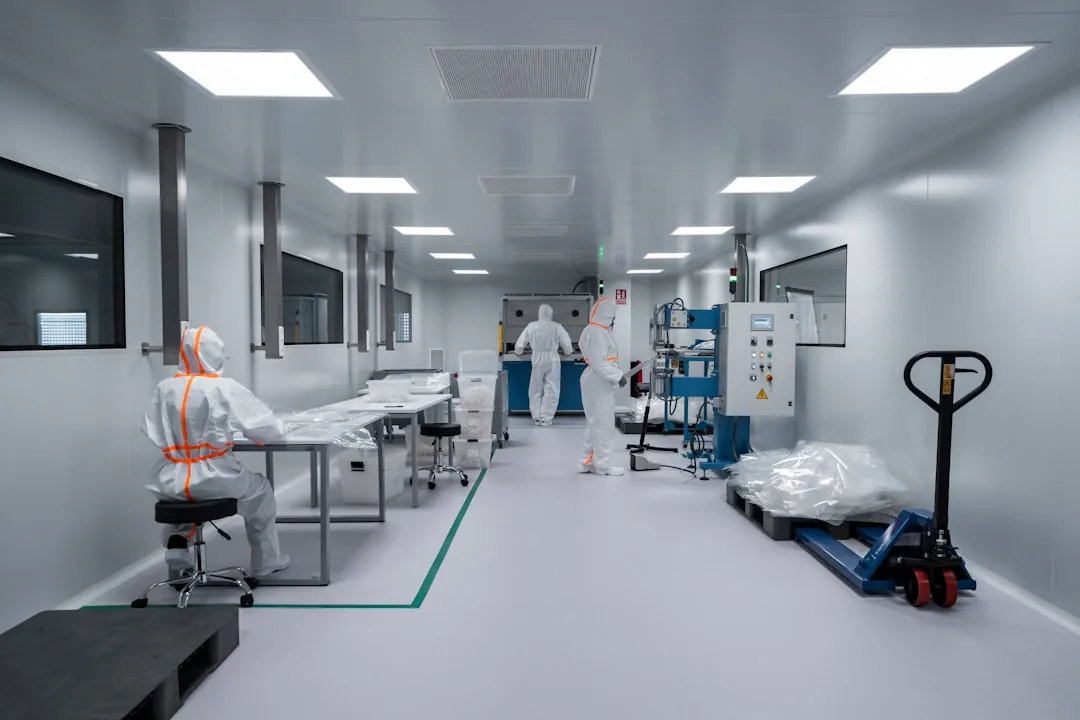 Photo: TECNIC Bioprocess Solutions / Unsplash
The Five Chemistry Deliverables in an IND Package
A complete IND-enabling chemistry program produces five linked deliverables. Most slip risks come from sequencing them wrong or under-investing in the early ones.
1. Confirmed Synthetic Route and Process Development Report
The discovery route — the way medicinal chemistry first made the molecule — almost never survives the move to GMP. Reagents are too expensive, steps are too long, chiral resolutions are inefficient, or the route uses chemistry that does not scale safely. A capable CRO will run a route-scouting study, then deliver a process development report that defines:
- The selected route, with rationale vs. alternatives considered
- Process safety review for each step, including DSC and reaction calorimetry where warranted
- Critical process parameters (CPPs) and proven acceptable ranges for each step
- Yield, purity, and impurity formation across two to three confirmatory runs
- A reference batch record ready for GMP execution
This phase costs $300K to $1.5M depending on molecular complexity. It is not optional. The sponsors who skip it pay double during GMP scale-up.
2. GMP-Grade Drug Substance Synthesis (Phase 1 Quantities)
Phase 1 typically requires 100 g to 5 kg of drug substance, depending on dose, dosing schedule, and the planned safety margin for the trial. The GMP campaign happens in a manufacturing suite under documented procedures, with deviation tracking, batch reconciliation, and full release testing. Material is shipped with a Certificate of Analysis matched to the registered specification. A CRO offering GMP custom synthesis at the right scale will:
- Run the campaign in suites previously inspected by FDA or another stringent regulatory authority
- Provide quality unit oversight independent of the manufacturing team
- Ship retained samples for stability, reference standards, and reserve
- Deliver a Module 3.2.S.2 batch record narrative ready for the regulatory filing
3. Analytical Method Development and Qualification
Methods that worked in discovery need to be re-developed for the regulatory environment. The sponsor needs:
- Identity (NMR, IR, sometimes MS)
- Assay (typically HPLC-UV with reference standard)
- Related substances (HPLC, often coupled to MS for impurity ID)
- Residual solvents (GC-headspace per ICH Q3C)
- Elemental impurities (ICP-MS per ICH Q3D)
- Water content (Karl Fischer)
- Optical purity for chiral APIs (chiral HPLC or SFC)
- Solid-form characterization (XRPD, DSC, TGA) for crystalline drug substance
Each method must be qualified — accuracy, precision, linearity, specificity, range, robustness — before use in GMP release. A partner with analytical method development services builds this package alongside the process work, not as an afterthought.
4. Impurity Profiling and Specification Setting
Impurity profiling is where many IND submissions stall. ICH Q3A requires that impurities at or above 0.10% in the drug substance be identified, and impurities above the qualification threshold be toxicologically qualified. The CRO’s job is to:
- Detect and characterize every impurity ≥0.10% by LC-MS or prep-LC isolation followed by NMR
- Synthesize impurity reference standards where impurity ID is required for the spec
- Recommend specification limits supported by the manufacturing data and toxicology coverage
- Build an impurity-fate-and-purge story across the route — which step generates each impurity and which step removes it
Underestimating this work is a frequent cause of IND clinical holds. Allow eight to twelve weeks for impurity ID even on a moderately complex molecule.
5. Stability Testing (Accelerated and Real-Time)
Stability testing under ICH Q1A starts as soon as the GMP lot is released. For a Phase 1 IND, the FDA expects:
- At minimum three months of accelerated stability data (40°C / 75% RH)
- Real-time stability data (typically 25°C / 60% RH or 30°C / 65% RH) initiated and ongoing
- A protocol committing to continued time points through the clinical use period
Stability storage and pull-point testing run for the full life of the program — a CRO with calibrated stability chambers and validated storage protocols saves the sponsor the cost of building this capability internally.
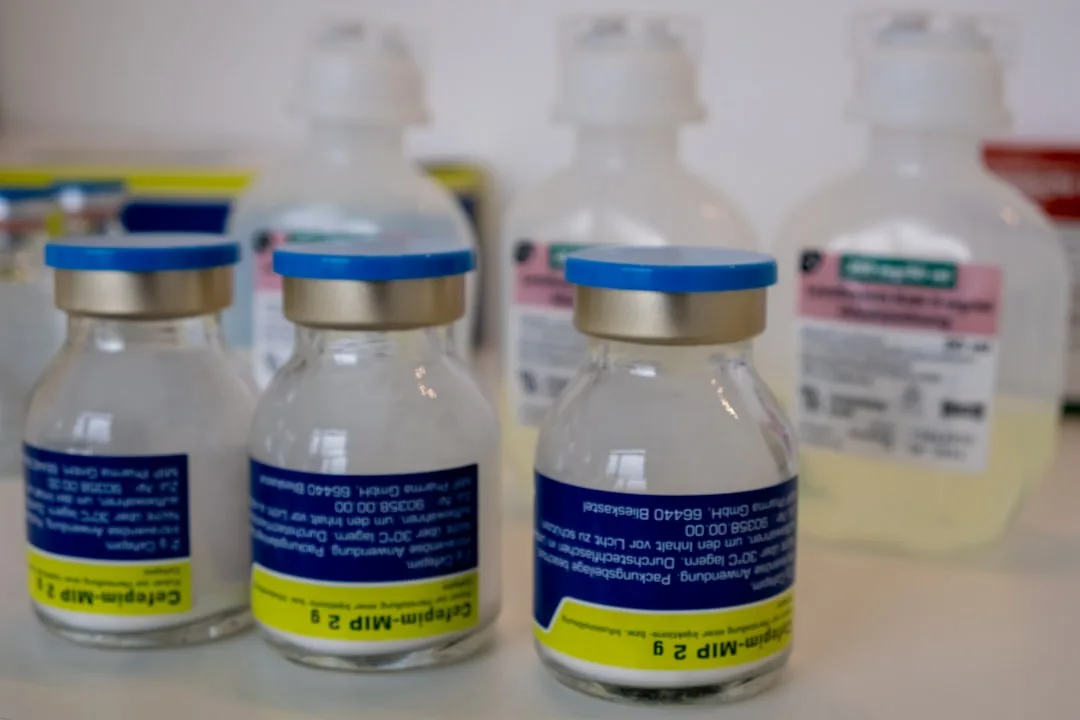 Photo: Julia Taubitz / Unsplash
Build vs. Outsource: The Real Cost Comparison
Series A and B biotechs frequently underestimate the cost of building IND-enabling chemistry capacity in-house. The build-vs-buy comparison is rarely close.
Internal Lab Cost to Run GMP-Grade Synthesis
To run a 1-kg GMP campaign internally, a biotech needs:
- A qualified GMP suite (lease + qualification: $2M to $5M up-front)
- A quality unit headcount (3 to 5 FTE: $700K to $1.2M annually loaded)
- Process chemistry headcount (4 to 8 FTE: $1.0M to $2.0M annually)
- Analytical chemistry and stability storage (2 to 4 FTE plus instruments: $800K to $1.5M annually)
- Document management system, training program, and audit infrastructure
Total first-year cost: $5M to $10M before any drug substance ships. This makes economic sense at maybe 5+ molecules per year — far above the throughput of any Series A pipeline.
CRO Cost and Time-to-IND Comparison
The same 1-kg GMP campaign at a CRO, including process development, methods, GMP execution, impurity work, and three months of accelerated stability, runs roughly $1.5M to $4M depending on molecule complexity and chiral content. The CRO absorbs the fixed costs of facility qualification, quality systems, and regulatory experience across many sponsors.
The time advantage is at least as large. A specialist CRO with the suite already qualified, methods platforms already in place, and process chemists who have run dozens of similar campaigns can compress the chemistry critical path from a typical 12 to 18 months internally to 6 to 9 months. For a venture-backed biotech, six months of additional runway is worth more than the chemistry budget.
The GMP vs non-GMP manufacturing decision covers the line where a sponsor truly needs GMP versus when non-GMP material with full release testing is acceptable.
How to Select a CRO for IND-Enabling Chemistry
Selection is where most sponsors go wrong. Three filters matter more than the rest.
FDA Registration and Inspection History
Confirm the CRO’s manufacturing site is FDA-registered for the API class you need (small molecule, peptide, oligonucleotide). Ask for the date and outcome of the most recent FDA inspection. A site with a clean recent inspection or no Form 483 observations on critical findings is a meaningfully de-risked partner. A site that has not been inspected in five years carries unknown risk that you do not want to absorb on a clinical timeline.
Process Chemistry Depth vs. Catalog Chemistry CROs
Some CROs are excellent at making catalog quantities of intermediates but have never optimized a route for GMP. Process chemistry depth is the variable that separates a 75% first-time-right campaign from a 35% one. Ask:
- How many INDs has the team supported in the last three years?
- Show me a process development report you delivered for a similar molecule
- What is your typical route-scouting timeline before you commit to a campaign?
- How do you handle scale-up from lab to pilot — what is the process chemistry path from lab to pilot?
Project Management Model and Communication Cadence
A weekly call, a shared project plan, and a single accountable program manager are the difference between an on-time campaign and a slipping one. Confirm:
- A named project manager with chemistry training, not just account management
- Weekly status calls with a written agenda and decision log
- A change-control process that flags scope changes before they consume budget
- Direct chemist-to-chemist contact when project decisions need it
The evaluation guide for choosing a custom synthesis CRO gives a longer scoring rubric for vendor qualification.
 Photo: National Cancer Institute / Unsplash
Typical IND-Enabling Timeline: 9 to 18 Months, Compressed to 6 to 9 with the Right CRO
A reasonable IND chemistry timeline for a small-molecule API of moderate complexity:
| Phase | Internal team | Specialist CRO |
|---|---|---|
| Route scouting and selection | 3-5 months | 1-2 months |
| Process development and confirmatory runs | 3-5 months | 1.5-2 months |
| Analytical method development and qualification | 2-4 months (parallel) | 1.5-2 months (parallel) |
| GMP campaign and release | 2-3 months | 1.5-2 months |
| Impurity ID and qualification | 2-3 months | 1.5-2 months (parallel) |
| Initial accelerated stability | 3 months | 3 months |
| Total chemistry critical path | 12-18 months | 6-9 months |
The CRO compression comes from parallelization, suite availability, and existing analytical platforms — not from cutting corners. A vendor selling you a four-month chemistry path is selling you risk.
ChemContract Research: IND Chemistry Services Overview
ChemContract Research has supported IND-enabling chemistry programs for venture-backed biotechs and mid-cap pharma since 2000. Across our 60+ R&D and manufacturing facilities and 500+ scientists, we deliver:
- Route scouting and process development — including DoE, kilo-lab confirmation, and process safety
- GMP drug substance synthesis — milligram to multi-kg, supporting biotech industry sourcing and pharma programs
- Analytical method development and qualification — full Module 3 method package
- Impurity profiling, isolation, and reference standard synthesis
- ICH stability testing — accelerated and real-time, with full study management
- CMC document support — Module 3.2.S deliverable with the campaign
Quote turnaround is 24 hours. Standard process development engagements start within four weeks of CDA execution. Every IND-enabling program is run by a named PhD-level project chemist with documented IND experience.
If you are scoping the chemistry budget for an upcoming IND or rebuilding a program after a vendor problem, request a quote with target structure, projected dose, and IND target date — we will return a fit-for-purpose proposal inside one business day.
Frequently Asked Questions
1. How much does IND-enabling chemistry cost at a CRO? A small-molecule IND-enabling chemistry program typically costs $1.5M to $4M at a competent CRO, covering route scouting, process development, GMP manufacture of 100 g to 5 kg of drug substance, analytical method qualification, impurity profiling, and three months of accelerated stability data. Highly chiral molecules, peptides, and oligonucleotides cost more.
2. How long should an IND-enabling chemistry program take? With a specialist CRO, the chemistry critical path runs 6 to 9 months from PO to GMP-released drug substance. Internal teams without GMP infrastructure typically take 12 to 18 months. Stability testing continues in parallel through Phase 1.
3. What is the minimum drug substance quantity needed for a Phase 1 IND? Most Phase 1 INDs require 100 g to 5 kg of GMP drug substance, depending on dose strength, dosing schedule, and trial size. Allow an additional 10-30% for retain samples, stability, and reference standards.
4. Should we outsource analytical method development too, or keep it internal? Outsource it to the same CRO running the synthesis. Methods developed by the team that knows the process and the impurities qualify faster and produce a tighter Module 3 package than methods built in isolation.
5. Do we need GMP material for IND-enabling tox studies? Generally no — IND-enabling toxicology can use non-GMP material released against a defined specification, provided the tox lot’s impurity profile bounds the GMP clinical material. This saves time and money. Check with regulatory before scoping the campaign.
6. What’s the biggest mistake biotechs make when picking an IND-enabling CRO? Choosing on price alone. The cheapest quote almost always omits process development, impurity work, or method qualification — leaving the sponsor to absorb the cost when those gaps surface during FDA review or clinical hold. A 15-20% premium for a CRO with documented IND experience pays back in months of saved timeline.
Key Takeaway
IND-enabling chemistry is not catalog work, and a procurement-first approach to selecting a partner will leave a Series A biotech with a slipped timeline and an inadequate CMC section. The right partner brings process chemistry depth, FDA-ready analytical method validation, GMP manufacturing capacity matched to your dose projection, and a project manager who flags problems before they become slip risks. Spend the time qualifying that partner — the alternative is months added to your IND timeline, and runway is the one resource you cannot synthesize.
Ready to Move Your Project Forward?
Partner with ChemContract for reliable sourcing, custom synthesis, and full regulatory compliance.