In 2026, the gap between quoted unit price and actual total landed cost for internationally sourced chemicals has never been wider. Trade policy volatility, regulatory complexity, and logistics disruptions have created an environment where the apparent savings of international sourcing frequently evaporate — or worse, result in higher total costs than domestic alternatives. This analysis examines the full cost picture that every procurement leader needs to understand.
Verify current rates before acting on this post. The tariff percentages below were accurate when this article was published. Duty rates change by executive action and vary by HTS classification, so confirm the rate for your specific line item against the USITC Harmonized Tariff Schedule and the USTR enforcement actions page before you rebuild a cost model. Our Section 232 landed-cost guide explains the calculation method, which does not go stale.
Building a Total Cost of Ownership Framework
A meaningful total cost of ownership (TCO) analysis for international chemical sourcing must capture every cost incurred from the moment a purchase order is issued to the moment material is released for use. Most procurement teams evaluate international suppliers on unit price alone — or at best, on landed cost that includes freight and duties. This approach systematically understates the true cost by 30% to 60% for most chemical categories.
A comprehensive TCO framework includes at least 12 distinct cost categories. Each one is quantifiable, and each one favors domestic sourcing to varying degrees. The sections that follow break down each category with specific dollar figures and calculation methodologies drawn from real procurement data.
Freight and Logistics Costs
International chemical shipping costs vary dramatically based on origin, mode of transport, shipment size, and hazmat classification. Understanding the full range of logistics expenses is essential.
Ocean Freight
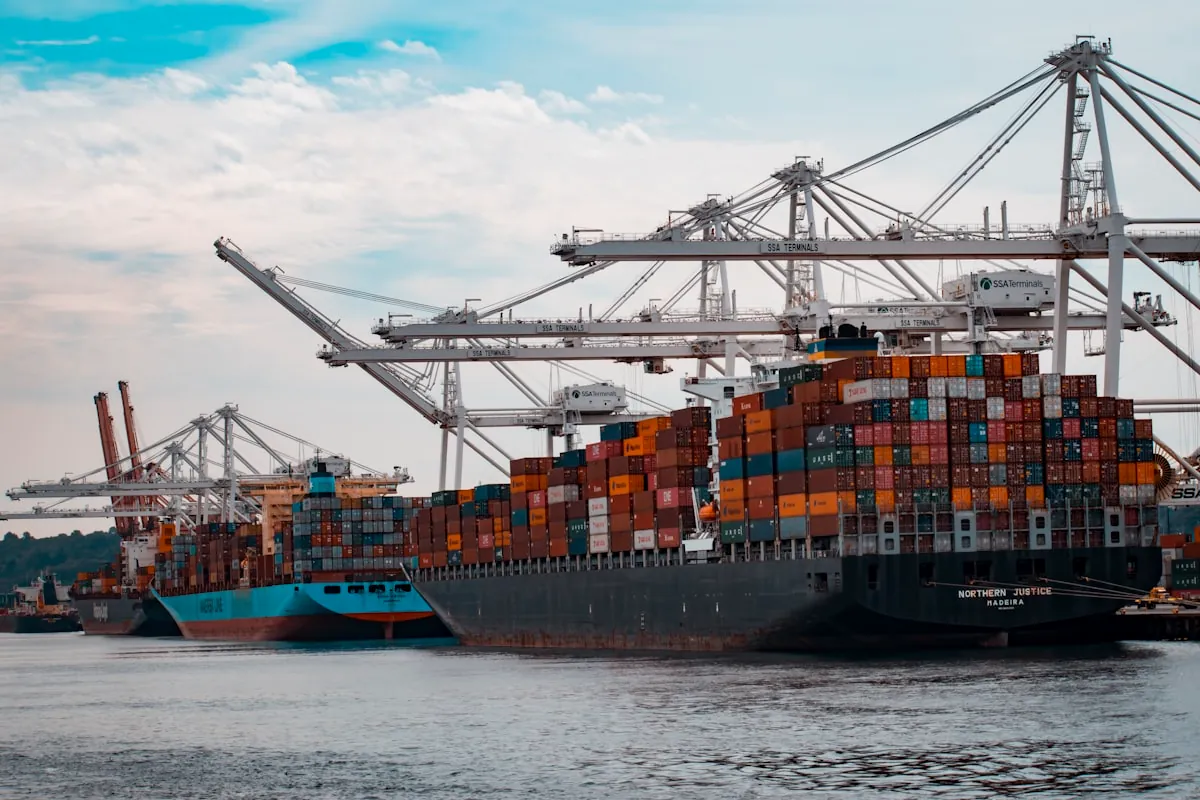
Ocean freight remains the primary mode for bulk chemical imports. Rates fluctuate with global container capacity, fuel surcharges, and trade lane demand. As of early 2026, representative rates from major chemical-exporting regions include East Asia to U.S. West Coast at $3,500 to $5,500 per 20-foot equivalent unit (TEU) for full container loads (FCL), East Asia to U.S. East Coast at $5,000 to $7,500 per TEU (via either Panama Canal or Suez routing), and India to U.S. Gulf Coast at $3,000 to $4,800 per TEU. For less-than-container-load (LCL) shipments — common for specialty chemicals purchased in smaller quantities — costs rise dramatically on a per-kilogram basis. LCL rates from China currently run $120 to $200 per cubic meter, with minimum charges of $300 to $500. For a 500 kg shipment of a specialty intermediate occupying 1.5 cubic meters, LCL freight alone adds $0.36 to $0.60/kg before any other charges.
Air Freight
When lead times compress, air freight becomes necessary. Air cargo rates for chemical shipments from Asia to the U.S. range from $4.50 to $8.00/kg for standard cargo and $7.00 to $14.00/kg for hazardous materials requiring DG (dangerous goods) handling. A 200 kg urgent shipment of a non-hazardous intermediate at $6.00/kg adds $1,200 in freight alone — often eliminating any unit price advantage entirely.
Domestic Comparison
Domestic ground freight for chemical shipments within the continental U.S. typically costs $0.15 to $0.50/kg for LTL (less-than-truckload) and $0.08 to $0.25/kg for full truckload, with transit times of 2 to 5 business days. The freight cost differential alone between international and domestic sourcing ranges from $1.00 to $5.00/kg for most specialty chemicals.
Tariff and Duty Calculations
Tariff costs are the most visible — and most volatile — component of international sourcing expense. For a detailed timeline of tariff escalation, see our guide to the tariff trap in global chemical sourcing. Accurate tariff calculation requires understanding HTS classification, applicable duty rates, and bonding requirements.
HTS Classification Complexity
The Harmonized Tariff Schedule assigns every imported product a 10-digit classification code that determines the applicable duty rate. Chemical classification is notoriously complex. A single compound may be classifiable under multiple headings depending on its purity, form (powder vs. solution), intended use, and whether it falls under specific pharmaceutical exemptions. Misclassification can result in overpayment of duties (no refund without filing a protest within 180 days), underpayment triggering CBP penalties of 20% to 40% of the unpaid duty, or seizure of goods at the port pending resolution.
Current Duty Rate Landscape
As of early 2026, duty rates on chemical imports vary widely. Standard MFN (Most Favored Nation) duty rates for organic chemicals under HTS Chapter 29 range from 3.7% to 6.5% ad valorem. However, Section 301 tariffs on Chinese-origin chemicals add 25% to 145% depending on the specific HTS code and product category. Anti-dumping and countervailing duties on specific chemical categories from certain countries can add an additional 15% to 200%. For a Chinese-origin specialty intermediate quoted at $50/kg, applicable tariffs could range from $14.25/kg (28.5% combined rate) to $72.50/kg (145% rate) — a spread so wide that procurement cost modeling becomes nearly impossible without dedicated trade compliance expertise.
Bonding Costs
Importers must maintain a customs bond to clear goods through U.S. Customs and Border Protection. A continuous entry bond, required for frequent importers, costs $0.50 to $1.00 per $1,000 of total import value annually, with minimum premiums of $500 to $2,000 per year. Single-entry bonds for occasional imports cost $5 to $10 per $1,000 of shipment value with minimums of $50 to $100 per entry. These costs are small individually but accumulate across dozens of shipments annually.
Customs Brokerage and Administrative Fees
Every international chemical shipment requires customs brokerage services. A licensed customs broker files the entry documentation, pays duties on behalf of the importer, and manages CBP interactions. Standard brokerage fees include entry filing at $125 to $350 per shipment, ISF (Importer Security Filing) at $35 to $75 per shipment, classification advisory services at $100 to $250 per new product, and post-entry amendment filing at $75 to $200 per amendment. Beyond the broker, additional administrative costs include freight forwarder coordination fees of $100 to $300 per shipment, demurrage charges of $150 to $350 per container per day for port delays exceeding free time (typically 3 to 5 days), detention charges of $100 to $250 per container per day for equipment held beyond the free time at the importer’s facility, and exam fees of $300 to $1,000 when CBP selects a shipment for physical inspection.
For a procurement operation managing 30 international chemical shipments per year, brokerage and administrative costs alone total $10,000 to $25,000 annually — often an invisible line item that never appears in price comparisons.
Currency Exchange Risk
International chemical purchases denominated in foreign currencies expose the buyer to exchange rate fluctuations between order placement and payment. This risk is often dismissed as minor, but historical data tells a different story.
The USD/CNY exchange rate has exhibited annual volatility of 5% to 8% over the past three years. The USD/EUR rate has shown similar swings. The USD/INR rate has been particularly volatile, with movements of 8% to 12% annually. For a $200,000 annual chemical spend denominated in a foreign currency, a 7% adverse exchange rate movement represents $14,000 in unplanned cost — pure margin erosion that hits the bottom line.
Hedging instruments (forward contracts, options) mitigate this risk but carry their own costs. Forward contract premiums typically run 1% to 3% of the notional value for 90-day contracts. Options provide more flexibility but cost 2% to 5% in premium. Many mid-market procurement operations lack the treasury infrastructure to manage currency hedging, leaving the risk fully unmitigated.
Lead Time Costs and Safety Stock Modeling
Extended lead times for international sourcing create inventory carrying costs that are consistently underestimated in procurement cost models.
Lead Time Comparison
International chemical sourcing from Asia typically requires 8 to 14 weeks from purchase order to material availability. This includes manufacturing lead time of 3 to 6 weeks, export documentation and port processing of 1 to 2 weeks, ocean transit of 3 to 5 weeks, and customs clearance and inland delivery of 1 to 2 weeks. Domestic sourcing typically delivers in 1 to 4 weeks, with many catalog and stock items available in 3 to 7 business days.
Safety Stock Formula and Carrying Costs
The additional lead time for international sourcing requires proportionally larger safety stock to maintain the same service level. The standard safety stock formula — safety stock equals the Z-score multiplied by the square root of (average lead time times demand variance plus average demand squared times lead time variance) — produces dramatically different results for international versus domestic lead times.
For a chemical consumed at 50 kg/month with a desired 95% service level (Z = 1.65), domestic sourcing with a 3-week lead time and 1-week variability requires approximately 35 kg of safety stock. International sourcing with a 12-week lead time and 3-week variability requires approximately 140 kg of safety stock — four times as much material sitting in the warehouse.
Inventory carrying costs typically run 20% to 30% of inventory value annually, encompassing warehouse space, insurance, capital cost, obsolescence risk, and handling. For a chemical valued at $80/kg, the incremental safety stock cost of international sourcing is approximately $1,680 to $2,520 per year for this single material. Multiply across a portfolio of 20 to 50 internationally sourced chemicals, and carrying costs add $35,000 to $125,000 annually.
Quality Assurance Costs
Quality assurance for internationally sourced chemicals carries costs that domestic sourcing largely eliminates.
Re-Testing Requirements
International Certificates of Analysis (CoAs) frequently do not meet U.S. pharmacopeial or internal quality standards. Issues include testing performed to non-USP methods, missing critical specifications (residual solvents, elemental impurities, water content), and data integrity concerns that require verification testing. Re-testing costs for a typical specialty intermediate range from $500 to $2,000 per batch depending on the analytical panel required. If 40% to 60% of international shipments require some form of re-testing — a typical rate for first-time and second-tier suppliers — the annual cost for a 20-material portfolio adds $4,000 to $24,000.
Rejection Rates
Rejection rates are not published on a comparable basis across the industry, so treat any single benchmark with suspicion — including this one. What is reliable is the mechanism: a longer chain with more handoffs, more transit time and slower feedback produces more rejections than a short one, and each rejection costs more because the replacement is further away. Track your own rejection rate by supplier and origin for a year and you will have better data than any published benchmark. A rejected batch triggers return shipping costs ($500 to $2,000 for international returns when possible), replacement lead time of 10 to 16 additional weeks, production schedule disruption costs that vary widely but often exceed $10,000 per incident, and investigation and CAPA documentation costs of $2,000 to $5,000 per event.
Compliance and Regulatory Costs
Importing chemicals into the United States triggers regulatory requirements that generate both direct costs and administrative burden.
TSCA Compliance
The Toxic Substances Control Act requires that all chemical substances imported into the U.S. be listed on the TSCA Inventory or be subject to a pre-manufacture notice (PMN) exemption. For a complete walkthrough of TSCA obligations, see our TSCA compliance procurement guide. TSCA compliance costs for importers include TSCA inventory verification at $200 to $500 per new substance, CDX (Central Data Exchange) reporting and filing fees, potential PMN submission costs of $10,000 to $50,000 for substances not on the inventory, and ongoing Chemical Data Reporting (CDR) obligations for substances manufactured or imported above 25,000 lbs annually.
SDS and Labeling Compliance
Safety Data Sheets from international suppliers frequently require translation, reformatting, or complete rewriting to meet GHS and OSHA HazCom 2012 requirements. SDS translation and compliance review costs $300 to $800 per document. For a portfolio of 25 internationally sourced materials, initial SDS compliance costs $7,500 to $20,000, with ongoing updates required when regulations change or supplier formulations shift.
Regulatory Consultant Fees
Many importers retain regulatory consultants to manage TSCA, EPA, and state-level chemical regulation compliance. Annual retainer costs for regulatory consulting services specific to chemical imports range from $15,000 to $50,000, depending on portfolio complexity and import volume.
Insurance Costs by Hazmat Classification
Insurance for international chemical shipments is significantly more expensive than domestic coverage, particularly for hazardous materials.
Marine cargo insurance for non-hazardous chemicals typically costs 0.3% to 0.5% of declared shipment value. For hazardous materials classified under IMO/IMDG codes, premiums rise to 0.8% to 2.0% of declared value, with surcharges for certain hazard classes (flammable liquids, corrosives, oxidizers) pushing costs to 2.5% to 4.0%. A $150,000 shipment of a Class 3 flammable intermediate incurs insurance costs of $3,750 to $6,000 — compared to $300 to $600 for equivalent domestic ground shipment coverage.
Opportunity Costs: The Hidden Multiplier
Perhaps the most difficult cost to quantify — but often the largest — is the opportunity cost of international sourcing delays and disruptions. Production delays caused by late-arriving international shipments cascade through manufacturing schedules. A single week of production downtime waiting for a critical intermediate can cost $50,000 to $200,000 in lost output depending on the product and facility. Missed market windows for product launches carry revenue consequences that dwarf the procurement savings that motivated international sourcing in the first place.
Additionally, procurement team bandwidth consumed by international logistics management — tracking shipments, managing customs issues, coordinating with freight forwarders, resolving quality disputes across time zones and language barriers — represents an opportunity cost. Every hour spent managing international supply chain complexity is an hour not spent on strategic sourcing, supplier development, or process improvement.
Detailed Side-by-Side Cost Comparison
To illustrate the TCO framework in action, consider a realistic procurement scenario: annual purchase of 2,000 kg of a specialty pharmaceutical intermediate, sourced from either an Asian manufacturer or a domestic supplier.
International Source (China): Unit price of $42/kg yields a base material cost of $84,000. Adding tariffs at a blended 45% rate adds $37,800. Ocean freight and inland delivery add $4,200 ($2.10/kg). Customs brokerage across 4 shipments adds $1,400. Insurance adds $840. Currency hedging premium (2%) adds $1,680. TSCA and compliance costs add $2,500. Quality re-testing (3 of 4 batches) adds $3,600. Safety stock carrying costs for the additional 280 kg at 25% of value add $2,940. Administrative overhead (estimated 120 hours at $65/hour) adds $7,800. The international total comes to $146,760, or $73.38/kg.
Domestic Source: Unit price of $68/kg yields a base material cost of $136,000. Domestic freight adds $1,000 ($0.50/kg). No tariffs, no customs brokerage, no currency risk, no TSCA import filings. Quality re-testing (1 of 8 batches at smaller, more frequent deliveries) adds $800. Minimal safety stock carrying cost adds $600. Administrative overhead (estimated 20 hours at $65/hour) adds $1,300. The domestic total comes to $139,700, or $69.85/kg.
The international source, with a unit price 38% lower than domestic, actually costs 5% more on a total cost basis. And this comparison does not include the risk premium for supply disruption, the probability-weighted cost of a rejected batch, or the opportunity cost of procurement team bandwidth — all of which further favor domestic sourcing.
Risk Premium Quantification
Beyond the calculable costs, international sourcing carries probabilistic risks that should be assigned financial values in any honest comparison.
Supply disruption risk can be quantified using historical disruption frequency and estimated cost per event. If international supply chains experience a material disruption (shipment delayed more than 4 weeks beyond expected arrival) once every 18 months, and the average cost of such a disruption (expedited air freight, production schedule changes, customer penalties) is $25,000, the annualized risk premium is approximately $16,700. Regulatory risk — the probability that a tariff change, trade restriction, or import requirement change renders current sourcing arrangements unviable — carries a lower probability but higher consequence. An annualized estimate of $5,000 to $15,000 is reasonable based on the frequency of trade policy changes in recent years. Quality consistency risk, encompassing the probability of receiving off-spec material that cannot be used, ranges from $3,000 to $10,000 annualized depending on the supplier’s track record.
The Domestic Sourcing Advantage
When all cost categories are honestly accounted for, domestic chemical sourcing provides a structurally lower total cost of ownership in the current trade and regulatory environment. This is not a marginal difference — it is a fundamental reshaping of the cost equation that has occurred over the past three years as tariffs, logistics costs, and regulatory complexity have simultaneously escalated.
ChemContract Research offers domestic sourcing that eliminates the entire TCO burden described above. Whether you need custom synthesis or compounds from our catalog of 7,000+ chemicals, transparent, all-inclusive pricing in U.S. dollars removes tariff exposure, currency risk, and customs costs from the equation. Lead times of 1 to 4 weeks dramatically reduce safety stock requirements and carrying costs. Every shipment includes complete regulatory documentation — CoA, SDS, and compliance certificates — that meets U.S. standards without re-testing or translation. And direct technical communication with our synthesis and analytical teams eliminates the quality ambiguity that plagues international supply chains.
Frequently Asked Questions
How much does international chemical sourcing really cost beyond unit price?
A comprehensive total cost of ownership analysis frequently reveals that international sourcing adds 30% to 60% on top of the quoted unit price. These hidden costs include tariffs, ocean freight, customs brokerage, currency hedging, quality re-testing, safety stock carrying costs, and administrative overhead. For specialty chemicals, the total landed cost from an overseas supplier often exceeds domestic pricing.
What is the biggest hidden cost in international chemical procurement?
Tariffs and duties are usually the largest single hidden cost, adding 15% to 45% for most chemical categories from China. However, opportunity costs — production delays from late shipments, procurement team bandwidth consumed by logistics management, and missed market windows — are often the most damaging, even though they are harder to quantify.
How do I calculate total cost of ownership for chemical sourcing?
A proper TCO framework should include at least 12 cost categories: base material cost, tariffs and duties, freight and logistics, customs brokerage, currency exchange risk, lead time and safety stock costs, quality assurance and re-testing, regulatory compliance costs, insurance, administrative overhead, risk premiums, and opportunity costs. Compare the sum across domestic and international options rather than relying on unit price alone.
Why is domestic chemical sourcing becoming more competitive?
Three factors have shifted the economics: tariff escalation (Section 301 rates of 25% to 145%), increased logistics costs and transit time variability, and growing regulatory complexity for imports (TSCA, GHS, customs compliance). When these costs are honestly accounted for, domestic sourcing often matches or beats international pricing on a total cost basis while delivering shorter lead times and lower risk.
What safety stock increase should I plan for with international sourcing?
International lead times of 8 to 14 weeks with 2 to 3 weeks of variability typically require 3 to 4 times more safety stock than domestic sourcing with 1 to 4 week lead times and 1 week of variability. At inventory carrying costs of 20% to 30% annually, this translates to $35,000 to $125,000 in additional carrying costs for a portfolio of 20 to 50 internationally sourced chemicals.
For procurement leaders evaluating total cost of ownership, the math increasingly favors domestic partners who deliver not just competitive pricing, but transparent, predictable, fully burdened costs that support better financial planning and lower operational risk.
Key Takeaway
The true cost of international chemical sourcing in 2026 extends far beyond the quoted unit price. When procurement teams conduct honest total cost of ownership analyses that account for tariffs, logistics, compliance, quality assurance, and risk premiums, domestic sourcing emerges as the more financially sound choice. The cheapest quote is rarely the cheapest solution.
Build a Resilient Supply Chain
Diversify your chemical supply with USA-based sourcing, cGMP compliance, and 2-4 week turnaround.