Hit-to-lead chemistry is the most underestimated stage of small-molecule drug discovery. The hit is real, the assay is reproducible, and a serious program is forming around it — but the chemistry organization sitting between confirmed binding and a developable lead series is often where months of preventable delay accumulate. A well-scoped hit-to-lead chemistry CRO engagement compresses that interval by parallelizing analog synthesis, running tighter SAR loops, and freeing internal medicinal chemists to think about target hypotheses instead of pipetting library plates. The decision to outsource is not philosophical. It is operational, and the math almost always favors a CRO once the analog count crosses about thirty compounds.
A well-run hit-to-lead chemistry CRO engagement compresses the path from confirmed HTS hit to a lead series typically by 30 to 60 percent versus an internal-only approach. The compression comes from three structural advantages — parallel synthesis throughput, dedicated SAR analytical capacity, and absorbed scheduling overhead — and not from any chemistry magic. R&D directors who treat the hit-to-lead stage as a queueing problem rather than a creativity problem reach lead nomination earlier, with cleaner data and lower internal headcount strain.
This guide walks through what hit-to-lead chemistry actually involves, the build-versus-outsource decision, how combinatorial synthesis accelerates SAR, and what a serious brief to a CRO partner looks like.
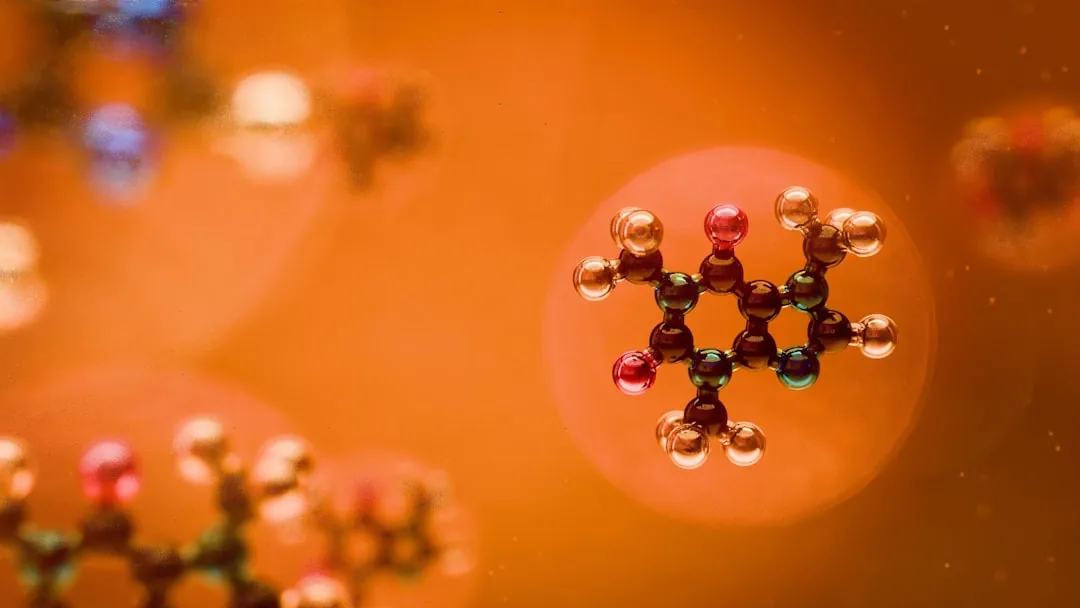 Photo by Omar Lopez-Rincon on Unsplash
What Is Hit-to-Lead Chemistry?
Hit-to-lead chemistry is the medicinal chemistry workstream that converts one or several confirmed primary screening hits into a chemical lead series — typically 5 to 15 compounds — with sufficient potency, selectivity, and physicochemical properties to justify lead optimization investment. The stage sits between high-throughput screening and lead optimization and is where most early-stage drug discovery programs either find traction or quietly stall.
The Boundary Between HTS and Lead Optimization
The HTS-to-hit-to-lead boundary is defined by the move from primary assay activity to confirmed structure-activity relationships. A primary hit might inhibit your target at 10 µM in a single biochemical assay; a hit-to-lead deliverable demonstrates dose-response at sub-µM, replicates in an orthogonal assay format, and shows interpretable trends across at least three substituent vectors. The boundary at the other end — into lead optimization — is the point at which the chemistry team has confidence in the chemotype and is willing to invest in iterative parameter optimization (potency, selectivity, ADME, PK).
Typical Deliverables: Analog Sets, SAR Data, Selectivity Profiles
A hit-to-lead campaign should deliver four artifacts:
- A focused analog library of 50 to 250 compounds covering the dominant SAR vectors around the hit
- Confirmed dose-response data in the primary assay plus at least one orthogonal format
- Counter-screen selectivity profiles against the closest off-targets and a panel of nuisance targets (PAINS, cytotoxicity, hERG)
- A written SAR summary that flags the chemotype’s tractability, the riskiest liabilities, and a route forward into lead optimization
Programs that finish hit-to-lead without the SAR summary almost always relitigate the same questions six weeks into lead optimization. The summary is the cheapest insurance you will buy in the project.
The Build-vs-Outsource Decision at the Hit-to-Lead Stage
The decision to keep hit-to-lead chemistry in-house is reasonable when the team has slack capacity, the chemotype is structurally familiar, and the analog count is small. It is rarely all three. Most early-stage programs hit at least one of those constraints.
Internal Medicinal Chemistry Teams: Capacity Bottlenecks
A senior medicinal chemist productively designs and personally executes 4 to 8 fully characterized analogs per week at lead-quality. Doubling that throughput requires either doubling headcount or outsourcing — there is no third option short of cutting characterization corners that come back as data-quality problems in lead optimization. For programs with three to five active hits-in-progress, internal capacity is exhausted almost immediately, and the program either narrows prematurely or accepts a slower SAR loop.
CRO Advantages: Parallel Synthesis, Faster SAR Cycles
A well-equipped hit-to-lead chemistry CRO runs parallel synthesis platforms that produce 24 to 96 analogs per cycle with consistent characterization, mass-directed purification, and integrated analytical turnaround in 7 to 14 days. The cycle time advantage compounds across iterations — three CRO cycles in a quarter produce comparable SAR coverage to roughly nine months of internal sequential work. The key is that the CRO is not replacing the medicinal chemist’s design judgment; it is removing the execution latency between design and data.
For deeper detail on how parallel synthesis platforms differ from sequential bench chemistry, see our overview of combinatorial chemistry libraries for drug discovery.
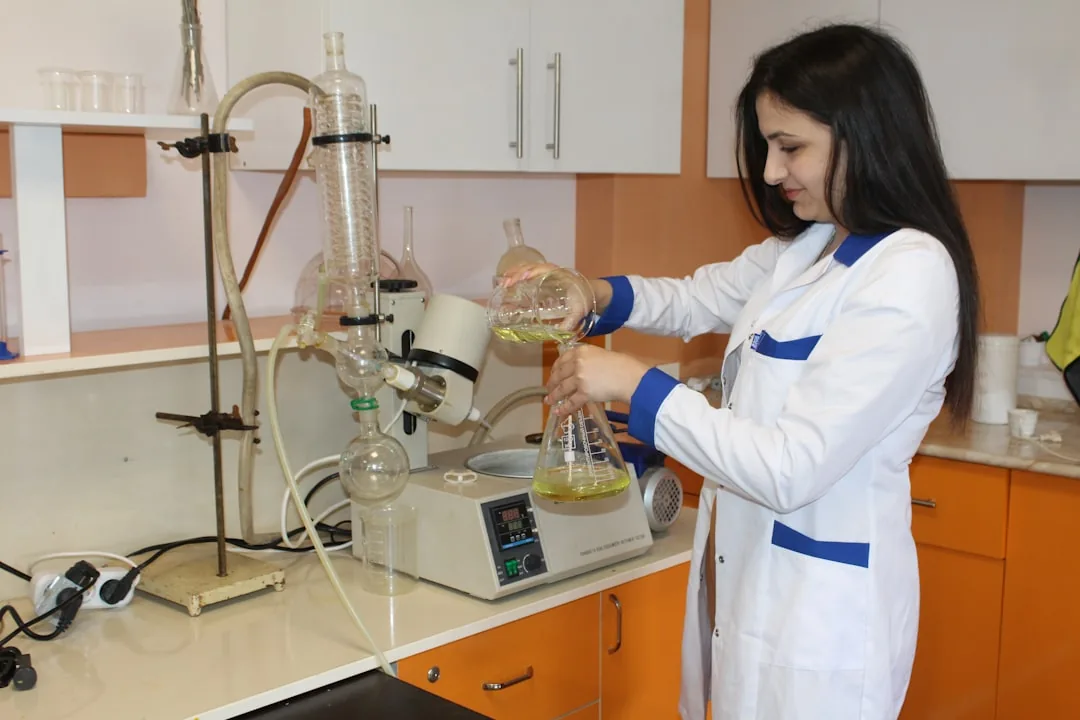 Photo by Harut Hayriyan on Unsplash
How Combinatorial Synthesis Accelerates Hit-to-Lead
The cost-per-analog economics of hit-to-lead chemistry tilt sharply once parallel synthesis is in the workflow. Combinatorial methods do not produce better molecules than focused medicinal chemistry — they produce more of them per dollar and per week, which is exactly the constraint at this stage of a program.
High-Throughput Analog Library Design
A focused hit-to-lead library is not a screening library. It is 50 to 250 compounds chosen to interrogate three to five specific SAR hypotheses around the confirmed hit. Library design starts from the chemist’s structural intuition — which positions on the scaffold tolerate substitution, which functional groups are likely to engage the target, which physicochemical vectors need to be tested — and converts those hypotheses into a synthesizable matrix of building blocks.
Automated Parallel Synthesis Platforms
Automated parallel synthesis platforms execute that matrix on equipment designed for repeatability and characterization throughput, not bespoke chemistry. Reactions are typically restricted to 10 to 25 well-validated transformations (amide coupling, reductive amination, SNAr, Buchwald, Suzuki, click chemistry, urea/sulfonamide formation) where the platform can guarantee yields within a defined window. Compounds are purified by mass-directed reverse-phase HPLC, with material delivered as DMSO solutions or solid samples on a defined timeline.
Rapid Turnaround for SAR-Driven Iteration
The end-to-end cycle from library design lock to characterized compounds in hand should be 14 to 21 days for a 96-compound library. Anything slower is a process problem at the CRO; anything faster is usually compromised characterization. The cycle time matters because hit-to-lead is iterative — three or four library cycles is normal, and the value of each cycle depends on the prior one’s data being available before design starts.
Analytical Integration: NMR, HPLC, and Mass-Directed Purification
The analytical package matters as much as the synthesis. A library compound delivered without confirmed identity, defined purity, and defensible mass is not a lead optimization input — it is a future failed assay. A serious hit-to-lead chemistry CRO delivers, for every compound:
- LC-MS confirmation of mass to within 5 ppm, with a UV-defined purity at 220 and 254 nm of 95 percent or higher
- 1H NMR consistent with the proposed structure, with deviations explicitly flagged
- A defined solubility or solution-stability assessment in the storage and assay solvent
- A documented chain of custody from synthesis through purification to vialing
Programs that skip the analytical package to save 10 to 15 percent on the synthesis cost spend that savings several times over investigating equivocal assay data. Buyers should also look for analytical depth comparable to what a dedicated analytical services lab delivers, particularly for programs where the chemotype carries known stability or impurity risks.
 Photo by Egor Myznik on Unsplash
What to Include in a Hit-to-Lead CRO Brief
Most hit-to-lead engagements that go sideways do so because the brief was incomplete. A serious CRO needs four pieces of information before it will quote a defensible timeline.
Structural Class and Confirmed Binding Data
Send the structure of the confirmed hit (or hits), the assay format and conditions, the dose-response curve, and any preliminary selectivity or counter-screen data. Vague briefs (“we have a kinase inhibitor hit”) generate vague proposals. Specific briefs (“low-µM CDK7 hit, biochemical IC50 50 nM, cellular EC50 1.2 µM, selectivity over CDK2 5x at 10 µM, structure attached”) generate executable plans.
Analog Targets: How Many Compounds, What Diversity
Define the library size, the substituent vectors of interest, and any explicit exclusions. A 96-compound library exploring three substituent positions costs and times very differently from a 250-compound library exploring core scaffold modifications. Tell the CRO whether the library is exploratory (broad, shallow) or focused (narrow, deep around a specific hypothesis).
Purity Requirements and Delivery Format
State the purity threshold, the deliverable format (solid, DMSO solution, solid plus DMSO), the quantity per compound, and the timeline. A standard hit-to-lead deliverable is 5 to 20 mg per compound at 95 percent UV purity, with both solid and DMSO stock; deviations from that profile change the cost meaningfully and should be specified up front.
Timelines: What a Well-Run Hit-to-Lead Program Looks Like
A representative hit-to-lead timeline runs 4 to 8 months end to end. The phases:
- Weeks 1 to 3 — kickoff, library design lock, building-block sourcing
- Weeks 4 to 6 — first parallel synthesis cycle, analytical, primary assay data
- Weeks 7 to 12 — second cycle informed by first-cycle SAR, expanded counter-screen
- Weeks 13 to 20 — third cycle, selectivity profiling, ADME triage, written SAR summary
- Weeks 21 to 32 — lead nomination, follow-up gram-scale synthesis of nominated leads, transition documentation into lead optimization
Programs that compress this into 12 to 16 weeks usually run two parallel CRO partnerships or accept a smaller library footprint. Programs that stretch beyond 9 months almost always have an internal-handoff bottleneck rather than a chemistry one. For broader context on how outsourced labs compress overall drug discovery timelines, see our analysis of contract R&D labs reducing time-to-market.
ChemContract Research: Hit-to-Lead Chemistry Services
ChemContract Research delivers integrated hit-to-lead programs combining our contract R&D capability for medicinal chemistry design and SAR interpretation with our combinatorial and automated synthesis service for high-throughput library execution. A single project manager owns the program end to end, eliminating the handoff seams that fragment hit-to-lead campaigns split across multiple vendors.
Our 500-plus scientists and 60-plus facilities support library sizes from 24 to several thousand compounds, with standard analytical packages (LC-MS, 1H NMR, HPLC purity at two wavelengths) included at no separate line item. Quote turnaround is 24 hours from a complete brief; first-cycle library delivery typically begins within three weeks of a signed engagement.
For programs that anticipate scaling nominated leads into IND-enabling work, our custom synthesis service provides a single-vendor path from milligram analogs through gram-scale lead resupply to multi-ton clinical manufacturing. Procurement teams considering the trade-offs between specialist-CRO and full-CDMO engagements may also find the framework in our CRO vs CDMO decision guide useful.
To start a project conversation, request a hit-to-lead quote with your structural data, library size, and timeline. The first reply will include a proposed library design philosophy, a defensible cycle-time estimate, and a candid view of where the program is most likely to bottleneck.
For benchmark guidance on the broader hit-to-lead and lead-optimization workflow used across regulated drug discovery, the NIH National Center for Advancing Translational Sciences (NCATS) drug development pipeline overview is the most useful public reference.
Frequently Asked Questions
What does a hit-to-lead chemistry CRO actually deliver?
A focused analog library of 50 to 250 compounds, dose-response data in the primary and at least one orthogonal assay, selectivity counter-screens against close off-targets and nuisance panels, and a written SAR summary that frames the chemotype’s tractability and the route into lead optimization.
How long does a hit-to-lead program take with a CRO?
A typical program runs 4 to 8 months from kickoff to lead nomination. Compressed timelines of 12 to 16 weeks are achievable with parallel CRO engagement or smaller library scope. Programs longer than 9 months usually have a handoff bottleneck rather than a chemistry one.
How much does outsourcing hit-to-lead chemistry cost?
Cost per analog at lead-quality typically ranges from $1,500 to $5,000 depending on chemistry complexity, characterization depth, and quantity. A 96-compound library with full analytical packages and 5 to 10 mg deliverable per compound usually quotes between $200,000 and $400,000 for the synthesis and characterization scope alone.
When should I keep hit-to-lead chemistry in-house?
Keep it in-house when the chemotype is structurally familiar to your team, the analog count is small (under 30 compounds), the team has demonstrable slack capacity, and the program does not need to advance against a hard external timeline. If any of those conditions fails, outsourcing usually wins on speed, cost, or both.
What information does a hit-to-lead CRO need to quote a project?
The structure and dose-response data for the confirmed hit, the assay format, any preliminary selectivity data, the desired library size and design rationale, the purity and quantity deliverable per compound, and the program timeline. Vague briefs produce vague quotes.
Key Takeaway
Hit-to-lead chemistry rewards velocity, not heroism. Programs that compress the interval between confirmed hit and lead nomination capture more useful SAR per quarter, retire risk earlier, and arrive at lead optimization with a chemical series chosen on data rather than convenience. A capable CRO partner is the cheapest way to buy that velocity. Pick the partner before the bottleneck appears, not after, and protect the internal team for the work only they can do — target biology, mechanism, and the strategic calls that no contract organization should be making for you.
Ready to Move Your Project Forward?
Partner with ChemContract for reliable sourcing, custom synthesis, and full regulatory compliance.